


Dear friends,
A great deal of ink has been spent recently passively describing what Europe supposedly cannot do. Much of the commentary discusses the continent the way relatives discuss someone faltering and in decline, with affection, but no substantial expectation of recovery. We find it immensely hard to share such malaise.
We spend our weeks studying Europe’s best people and companies, which turns out to be a poor vantage point for despair, and the more we do this, the more convinced we become that the opinion markets are selling Europe short, and that this is one of the great mispricings of our time. It is our mandate, then, to transfer to you, with the highest fidelity we can manage, our blunt optimism on European tech.
Very few companies make the task easier than Helsing. Over the past weeks we have put well over 175 hours into studying Europe’s most valuable defence tech company, reading and analysing everything available to mortals and civilians, in at least three languages, and I can say it plainly that I have rarely studied a startup this clear-headed and this directional. Even from a safe distance, the coherence of its philosophy, its belief system, its sense of what it exists to do, comes through with a force I have not encountered often.
Today we bring you what we believe is the most comprehensive account of Helsing anywhere: 10,000 words report on its origins, philosophy, mentality, team, strategy, product branches, and its blatant, shameless Europeanness. After working through books’ worth of material on a single company, condensing what it stands for into a single sentence proved beyond me. Luckily, it had already been done:
“We want to help give Europe its spine back.”
— Gundbert Scherf, Helsing Co-founder & Co-CEO, for Reuters
Here are the learnings that we managed to glean and condense:
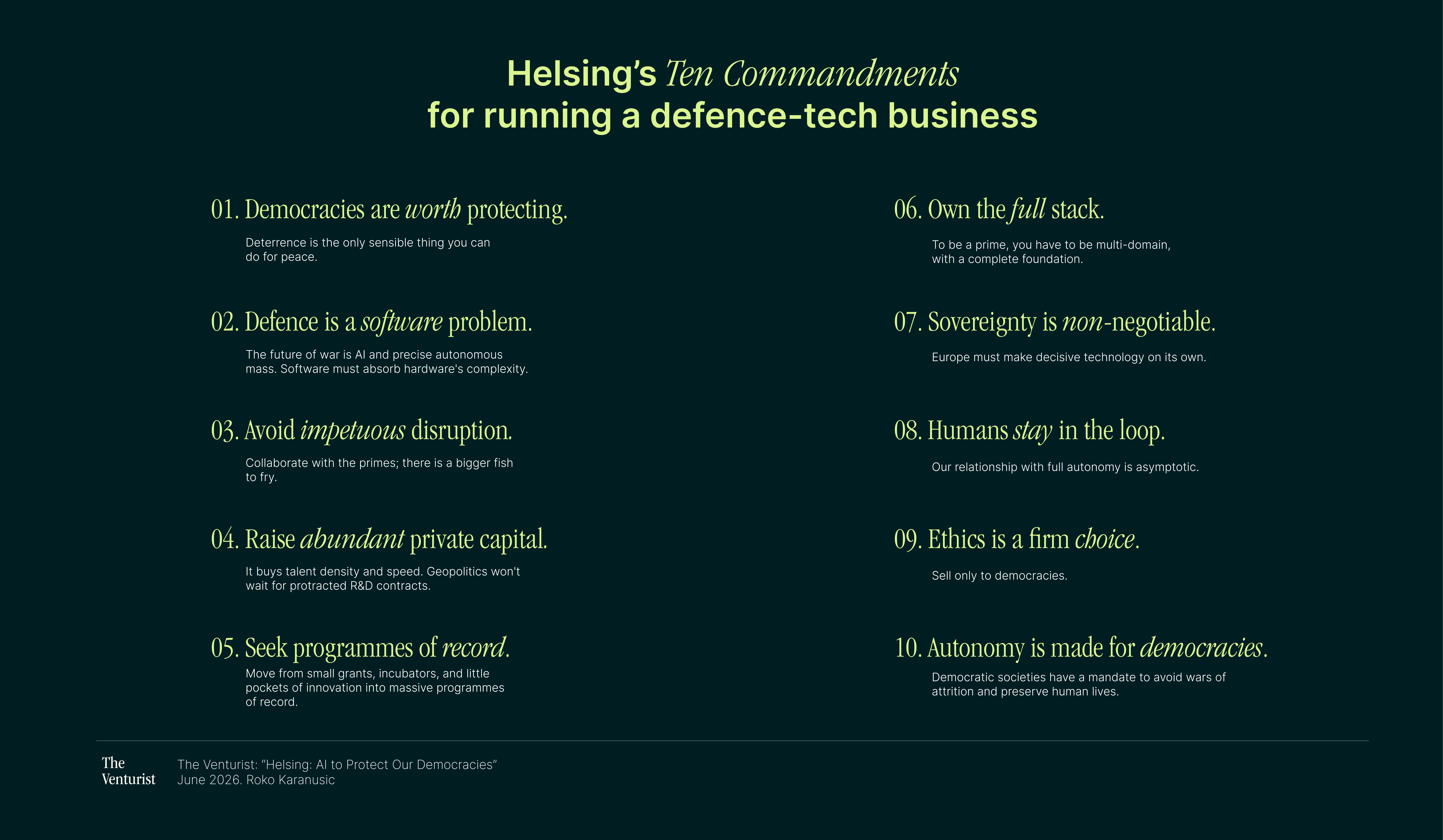
Democracies are worth protecting. Deterrence is the only sensible thing you can do for peace.
Defence is a software problem. The future of war is AI and precise autonomous mass. Software must absorb hardware’s complexity.
Avoid impetuous disruption. Collaborate with the primes; there is a bigger fish to fry.
Raise abundant private capital. It buys talent density and speed. Geopolitics won’t wait for protracted R&D contracts.
Seek programmes of record. Move from small grants, incubators, and little pockets of innovation into massive programmes of record.
Own the full stack. To be a prime, you have to be multi-domain, with a complete foundation.
Sovereignty is non-negotiable. Europe must make decisive technology on its own.
Humans stay in the loop. Our relationship with full autonomy is asymptotic.
Ethics is a firm choice. Sell only to democracies.
Autonomy is made for democracies. Democratic societies have a mandate to avoid wars of attrition and preserve human lives.
One more thing before we begin: we are preparing a guide to building in defence tech, written in collaboration with some of Europe’s finest investors and builders in the space. More on that soon.
Now, Helsing.
Study European technologies, companies, and people. The Venturist is the read for European venture insiders.
I
The World as It Was
“We understood what was going to happen”, Torsten Reil recalled the commotion across the broader European public following the Russian annexation of Crimea in 2014, “but we didn’t want to think it through, because it meant we’d have to start thinking about defence again — the consequences, the suffering that comes with it. We hoped it might go away.”
To grasp just how radical Helsing’s advent actually was, we need to remind ourselves of how things stood back in 2021, or even more so, in 2014. It is easy to lose your bearings in 2026, when Europe is actively preparing an estimated €800 billion in cumulative defence expenditure, when its allies outspend the US (strictly speaking military equipment procurement adjusted for PPP), when everyone is talking about defence and when everyone is trying to get into it.
In 2014 though, the very year of the annexation, German soldiers infamously trained with painted broomsticks in place of machine guns during a NATO exercise, a consequence of severe equipment shortages. The incident made international headlines in early 2015 and became a widely cited mockery symbol and byword of the Bundeswehr’s underfunding and equipment deficits in the decade prior to their major rearmament.
In 2021, only four EU member states reached NATO’s designated 2% military spending-to-GDP ratio. To put that in the perspective, today all but four EU member states (the neutral, non-NATO Austria, Ireland, Malta, and Cyprus) reach or exceed the target. Defence was largely filed away as tobacco or alcohol, in the feels good, is bad category, rather than feels bad, is good one.
The prejudice was not exclusive to Europe — recall Google’s withdrawal from Project Maven, the Pentagon’s initiative applying AI and computer vision to military drone footage, after mass employee protests and resignations from staff who feared their work was being adapted for lethal targeting. Carrying this current of thinking alongside the traumas of its own militarism, Europe, and especially its main engine Germany, kept its defence sector cautious and small, in line with the wider pacifist settlement.
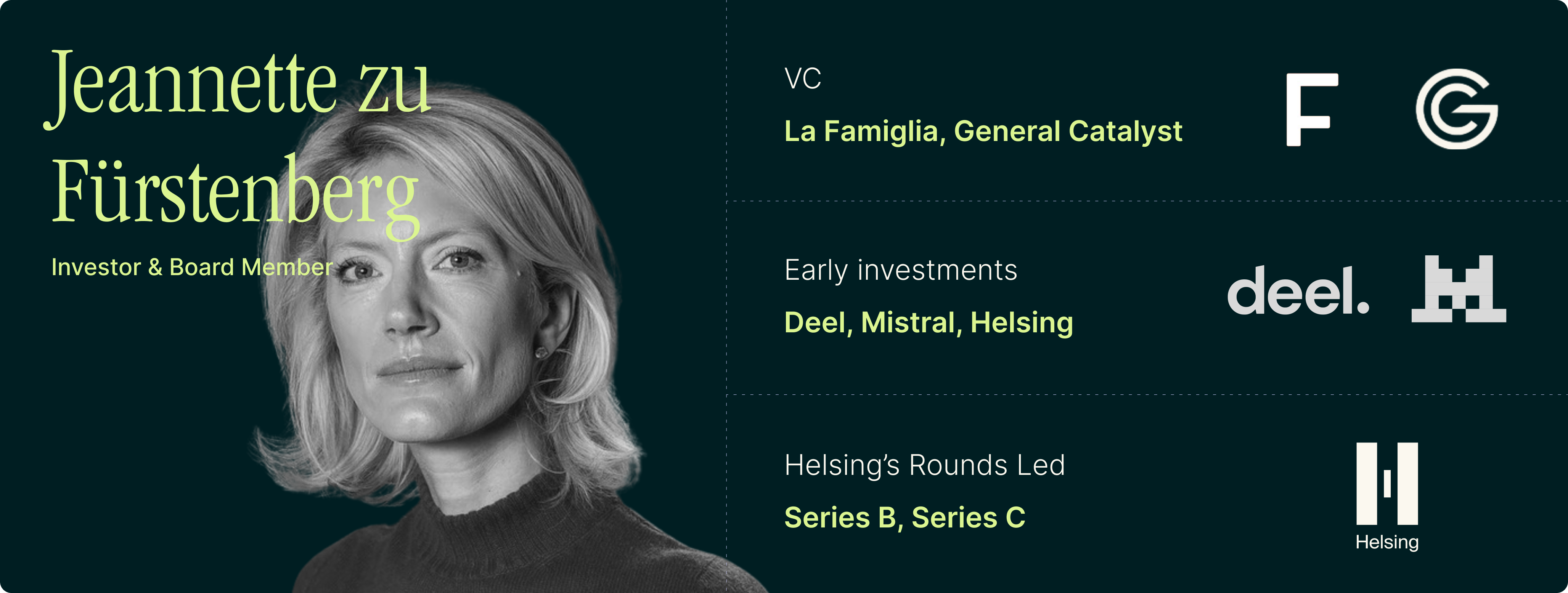
European VCs followed suit, reinforced by ESG mandates and ironclad, defence-averse LP agreements. Jeannette zu Fürstenberg, President and Managing Director of the global VC firm General Catalyst and a Helsing board member, recalled not being able to support the company’s seed round from her then-fund La Famiglia: “[Fund] was structured after the European fund standards, which basically means we were prevented from investing into defence or weapon systems. And so it would have required entire shareholder consent to change that in the course of a few weeks, which was impossible because at the time even my team was divided.” She added: “Everybody was hoping you could surf by with a pacifist system.”
General Catalyst was never so constrained, having invested in defence industry for a while, notably in Anduril in the US, with a firm belief that each region needs its own independent and sovereign defence prime. The firm went on to lead Helsing’s €209 million Series B and €450 million Series C, with zu Fürstenberg investing alongside through La Famiglia. At the time of Helsing’s series B, General Catalyst and La Famiglia were already in deep, confidential talks to merge their operations, which they did in October 2023, only a month after the fundraise.
Before any of that could take place, however, Helsing struggled to keep its cap table European, something the founders considered strategically important. “When we started four and a half years ago”, Reil reminded the audience at Resilience Media conference held last October, “it was impossible to raise from European VCs, and we wanted to start with European money to have a European cap table.” The European VCs were not interested in even touching defence: “Some of the reasoning were LP agreements restrictions, but in reality, a lot of them them didn’t want to do it reputationally, and they didn’t have courage to talk to their friends in the social circles that they are funding defence.”
Every heresy eventually finds its patron, and Helsing found one in the most famous consumer-tech founder in Europe. How much do you need, Daniel Ek asked the Helsing team, the first team he would officially back through Prima Materia, his highly selective startup studio into which he had devoted €1 billion of personal resources “to fund so-called moonshots”, the deep technology necessary to make a “significant positive dent”. His influence was immediately palpable for Reil and the team: “Daniel desensitises you to large numbers quite quickly because of the size of Spotify. He gives you permission to think big.”
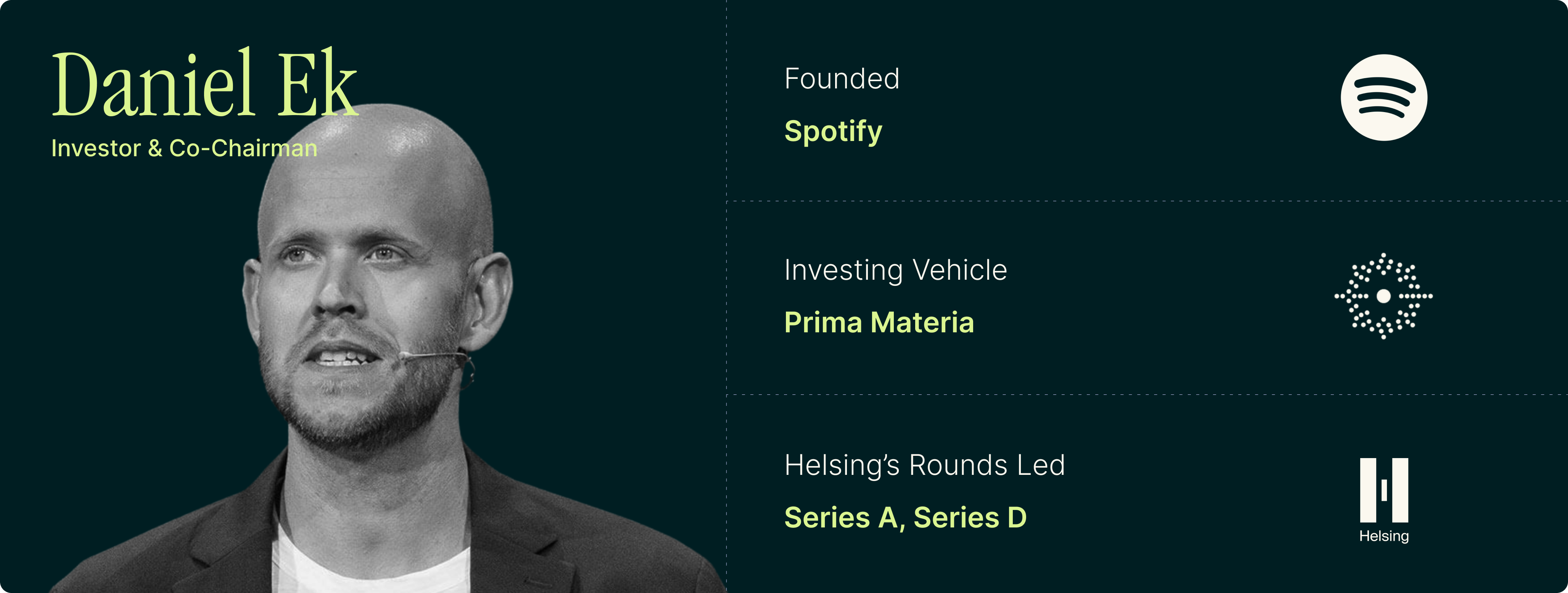
In November 2021, only four months after participating in Helsing’s €8.5 million seed round, Prima Materia and Ek had developed so much conviction that they cut a €100 million cheque, leading the €102.5 million series A round. The investment relationship caused the startup’s first major public controversy, a backlash that would eventually see artists and record labels pull their catalogues from the streaming service. The objection, as widely reported, was that fans’ money and artists’ creative labor were being funneled into defence tech and weaponry.
Both Spotify and Helsing issued their answers: Helsing clarified that its technology serves for deterrence and defence against Russian agression in Ukraine, and not elsewhere; while Spotify distanced itself by noting that Helsing is an independent venture of Ek’s, and not a corporate initiative. In late 2025, Ek stepped down as a Spotify’s CEO and transitioned into the role of Executive Chairman, a change implemented as part of a corporate restructuring plan, rather than any reaction to the backlash. The backlash, for what it is worth, never laid a finger on Helsing’s financing; Ek doubled down and led the staggering €600 million Series D in June 2025. Shortly after the round, he told the Financial Times:
“I’m sure people will criticise it, and that’s okay… I am 100 per cent convinced that this is the right thing for Europe.”
— Daniel Ek, Helsing Investor & Co-Chairman, for Financial Times
In the same interview, Ek explained his reasoning by noting that AI, mass, and autonomy are driving the new battlefield, adding that “the world is being tested in more ways than ever before”. And the hostile perception of defence was not the only thing that made the venture so contrarian at the time. In 2021, ChatGPT had not yet been released, and AI was not yet the category it would eventually become. “The whole idea to set up a company like this around software, when defence is this really hardware-centric thing was very contrarian, to say the least”, Scherf pointed out. Only eleven months after Helsing’s founding, the Russian armour crossed the Ukrainian border, and public and political sentiment changed almost overnight.
